Surveys can either be qualitative or quantitative. When conducting surveys you need to be mindful of the sample size, in order to accurately portray the views of the chosen demographic. It is important to avoid double negative questions and two concept questions. It is more common in today’s society to see surveys conducted online.
Advantages of Surveys
Online surveys are beneficial for firms as they tend to be relatively inexpensive. As suggested by Susan DeFranzo (2012) the number of potential responses could be thousands when you conduct an online survey. Conducting surveys online ofter the ability to be more flexible in comparison to paper surveys. You can minimise the error in accuracy from data collection when conducting online surveys. Survey platforms offer the ability to create graphs and charts. This then reduces the time bounds.
Surveys enable designers to gain an understanding of consumers, opinions, needs and wants, in regards to their design. Surveys can help designers identify gaps in the market because they can be very specific in wording. In relation to the sample size, there needs to be a large enough size in order to gauge an accurate representation. The ideal sale size would be 5000 people. It would be important for the designer to chose the profile of the candidates carefully as they need to represent the demographic they are surveying.
Disadvantages of Surveys
Where the need for consumers to be anonymous is beneficial for the consumers answering the questions online, this can be a disadvantage to the firm as they do not know the identity of the person. A firm would have to be mindful of this if they had a specific criterion, as they would not know who is answering the questions. Designers conducting this type of research method will need to be aware of the level of surveys consumers get directed towards them, as this could lead to possible cooperation problems (Cvent, 2016)
Directed Study
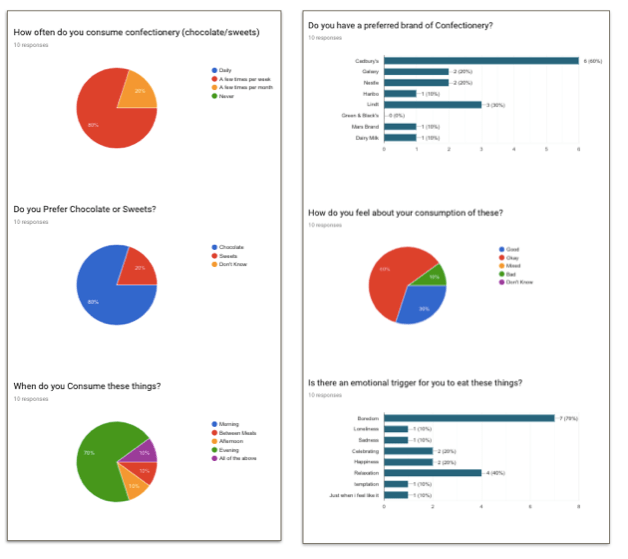
The task given required the students to formulate an online survey and distribute it to other students in their age bracket, 18-24. It was important to give an option to answer ‘do not know’ so that they do not force people into making a decision. The process of sharing the survey link online was beneficial as the students were able to acquire data fast. The outcome is shown below:
 Design Research Methods