As specified by Keats (2000, p. 1) interviews are used as a basic tool for firms to interact with their clients. Rowley (2012, p. 261) found that interviews are essential for designers in order to collect qualitative data such as opinions, experiences and behaviours. To fully understand how to refine a design, designers need to gain feedback from their consumer which can be done from interviews. (Preece, et. al, 2002, p. 5)
In relation to the length of an interview, that relies heavily on the purpose of the interview being conducted. Researches can take a theoretical approach whereby the length of the interview relies on the nature of the questions being asked. On the other hand, they can also take a more pragmatic approach where they take into consideration the amount of time the interviewee is will to give. This helps the interviewer know how many questions to ask.
Advantages of Interviews
A designer could conduct an in-depth interview with interviewees. It would be more similar to a conversation that has a specific purpose as indicated by Minichiello et al. (1995, p. 61). The use of this type of interview would be beneficial for a designer because it would help them to understand the consumer better in order to design the most useful product, that fits their needs.
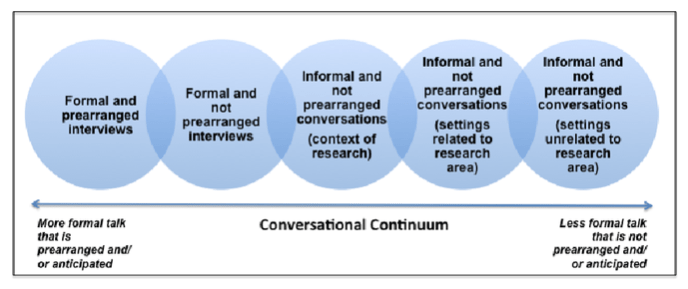
Daniel Grace’s diagram is useful in explaining the different type of interviews (Grace, 2013). The model shows that structured interviews are more formal compared to unstructured interviews which include, in-depth and clinical interviews.
Susan DeFranzo (2014) explored the ideas of interviews and their benefits to designers. Designers can use them as them they can gage verbal and non-verbal cues. Non-verbal cues could ultimately determine the engagement an interviewee has with the topic and help the designer know how passionate they are.
Disadvantages of Interviews
Interviews often required the researcher to prepare before conducting. As explained by Kevin Whorton (2016) designers need to be aware of the time constraints of interviews, they often digress from being structured if not planned properly and end up going off on a tangent. It important that the researcher does not “push for consensus”. This is also supported by Chandler-Ezell (2005, p. 417) who also goes on to suggest another disadvantage, not randomising the size of the sample, which as a result can cause bias.
The reliability of interviews can be taken into account as it is how the interviewer interprets the answer that has been given and how it is recorded. It is important to consider confidentially and to always remind the interviewee of this fact.
Directed Study
Students were tasked to go out into the centre and interview the general public on their social media usage. When creating the interview questions they had to consider the types of questions they were going to ask, their approach to asking people and whether or not the questions were easy to read. The outcome is shown below:
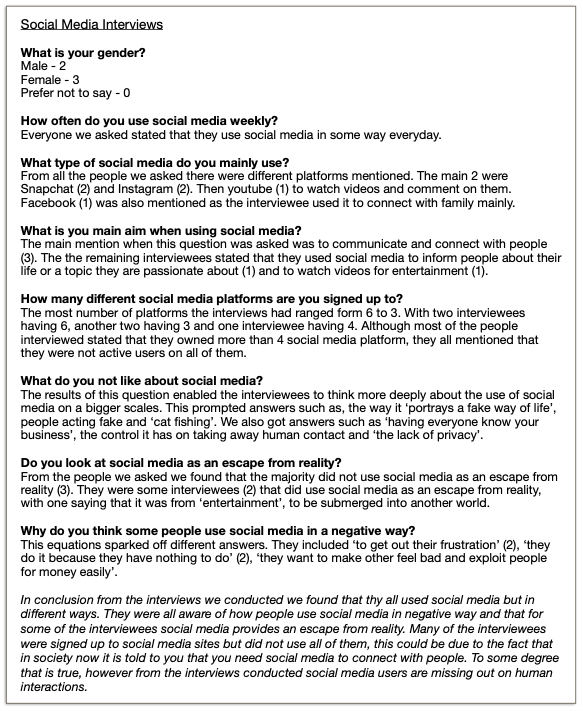
During the interviewing process, the students noted that some people were hesitant to answer the survey for different reasons, the main one was that they didn’t have time. The time they conducted their interview did impact on their results, as they conducted it during lunch hours.
 Design Research Methods