As stated by Jordan Nottrodt (2017) ethnography is a research method which involves you immersing yourself in participants environment to gain a more in-depth perspective of their lives. Ethnography comes from anthropology, the study of cultures, relationships and humans environments.
Advantages of Ethnography
Ethnography is an important research method for designers to use as it can help them to fully gauge the needs and wants of their chosen consumer. As explained by Butlewski et al (2016, p. 4) it also helps designers to understand people’s actions and enables them to adapt products and designs to suit the consumer. One organisation Spotless (https://www.spotless.co.uk/insights/ethnography-when-and-how/, no date), determined that ethnography can useful for a designer of a product as it can give them the opportunity to see consumers initial reaction and attitudes to a new product. This will help a designer to understand if their product meets the needs of the customer. They also have the opportunity to ask the consumer questions and conduct a style of an informal interview. With this, they would need to stay undetected and not ask very invasive questions.
Disadvantages of Ethnography
Researchers will need to be mindful of their method whether it is covert or overt. A covert initiative would include conducting the study in secret. (Graham R Gibbs, 2012). However, this does raise some ethical problems. Is the method being used justifiable? Working in a covert situation could lead to the researcher not being able to go to certain areas, which could then hinder the progress of their data and the application to their design.
Conducting an ethnographic study can be time-consuming and costly. Researchers will often go back to the same environment multiple times at different points in the day or year, in order to gain a full understanding of the participants in the environment they are studying. As cited by Cushion (2014, p. 176), Hammersley and Atkinson (1995) noticed that when it comes to ethnography there coulee be a “danger of over-rapport”, where the researcher can start to form a close relationship with the community they are immersed in. This can cause problems as to how reliable the findings of the researcher can be. This method of research wouldn’t be suitable for smaller business that has financial constraints.
Directed Study
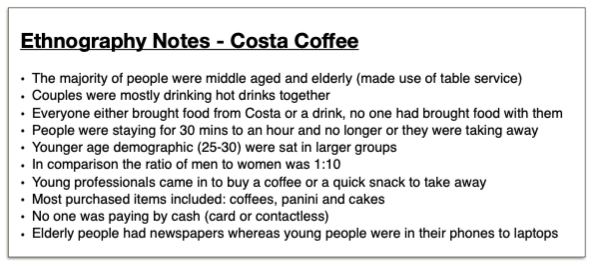
The students were directed to go out into the public and study people during lunch. One group studied people at Costa Coffee From their finding they noticed that many people purchased items using their cards and the young professionals coming into the store purchased items and left. As a result of the students purchasing items, they were not noticed by the public. The outcome is shown below:
 Design Research Methods